international activities
The International Team was established in 2024 in response to increasing global interest in headspace Denmark. Through international collaborations, we aim to expand the reach of the non-specialist, volunteer approach to new settings, learn from others to improve our offering within Denmark, and advocate for increased commitment and investment in civil society approaches to youth mental health. Some of our key projects are described in the section below.
Projects and International Engagements
Five key takeaways from the Nordic headspace conference 2025 – "Turn the tide: New approaches to youth mental health and early intervention"
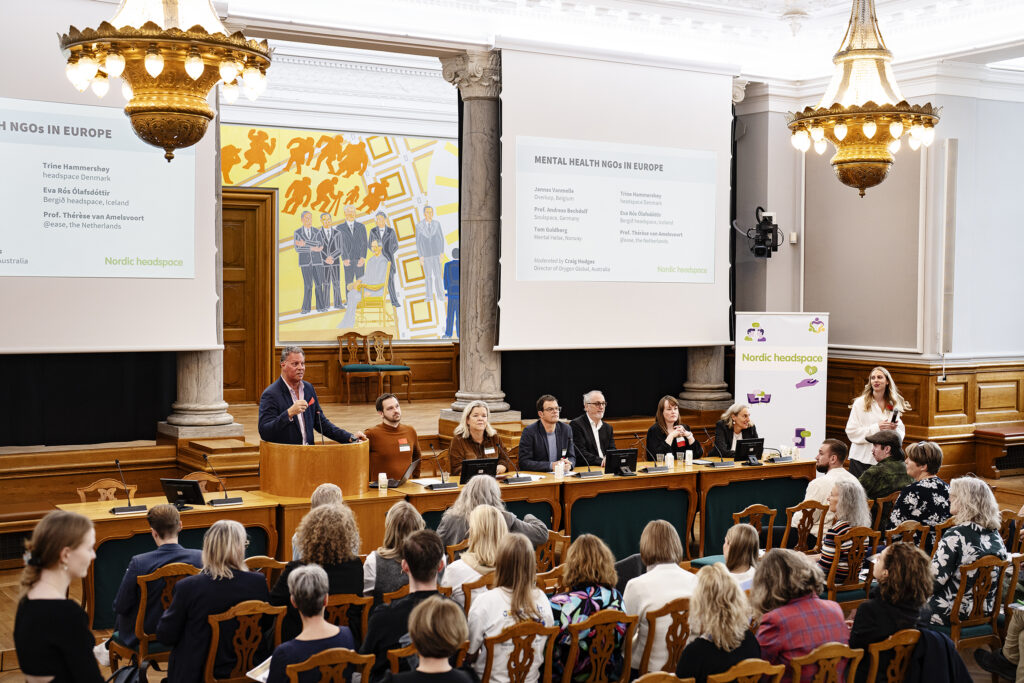
The Nordic headspace 2025 conference took place in the Fællessalen at the Danish Parliament, Christiansborg, bringing together 150 participants from 18 countries.
The conference gathered practitioners, policymakers and young people from the Nordic region and the rest of the world to share insights, knowledge and experiences to answer the big question: How do we turn the tide on young people's mental wellbeing?
Already the day before, a larger group of participants had effectively kicked off this year's conference by joining a workshop at headspace Denmark and visiting the local headspace centre in Lyngby. You can read more about the visit at the bottom of the page.
We would like to thank all participants at Nordic headspace for their commitment, their invaluable input and their tireless determination to improve young people's wellbeing across the globe.
Here are five key takeaways from the conference days.
1. Human connection is crucial in a digital age
A recurring theme throughout the conference was the concern that everyday encounters – small talk at the supermarket, a smile on the bus, a quick "hi" in the street – are slowly disappearing as digitalisation and automation increase.
As former Icelandic Minister of Social Affairs Árni Páll Árnason reminded us, these small, informal meetings and conversations are what keep us connected – and their absence affects not only young people's mental health, but all of ours.
This is a message that resonates strongly with headspace Denmark and clearly did so in the room as well: We must insist on presence, conversation and nurturing relationships in a daily life that can all too easily be reduced to screens, self-service solutions and isolation.
Prevention often begins with something as simple as someone asking: "How are you – really?"
2. Prevention and early intervention must play a much bigger role
WHO's representative, Dr Ledia Lazëri, put numbers to a well-known problem: Only 3.6% of global mental health budgets are allocated to prevention and promotion, even though we know this is where the greatest impact is achieved – both in human and economic terms.
She highlighted the services provided by the NGOs present and several others from around the world, including Zimbabwe, Italy and Latvia, where practitioners are already making a tangible difference by meeting young people where they are.
The message to decision-makers was clear: If we want to turn the tide, we also need to redirect the flow of funding. We must invest substantially more in prevention, early intervention and low-threshold services that can catch young people before they can no longer cope – and before the pressure on an already overburdened healthcare system increases even further.
3. Flexible civil society services work – but struggle with sustainability
Across international youth services, including our Nordic partners Bergið headspace and Mental Helse, the same experience emerged: When young people are met on their terms, in safe communities and within flexible frameworks it makes a real difference.
Tom Guldberg from Mental Helse in Norway shared how activities such as gathering a group of boys in a workshop and having them build something together over 6–8 months can open space for difficult conversations about life.
But from Bergið headspace in Iceland, we also heard how they still must fight year after year to secure funding, even though young people are clearly using the service. Several NGOs pointed to the paradox that success does not automatically lead to stability: The more in-demand and effective the services become, the greater the uncertainty if funding remains short-term and project-based.
The key point was that if we want a strong "ecosystem" around young people's mental health, we must ensure long-term, predictable conditions for the organisations that make a difference for young people.
4. Young people are experts in their own lives – and must be at the table
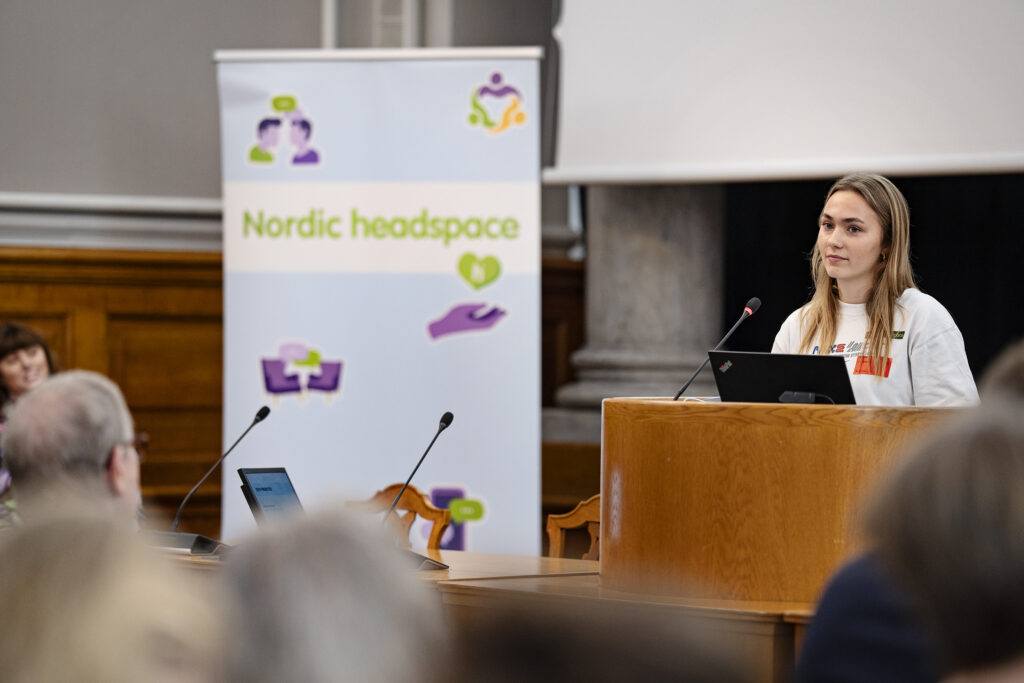
One of the strongest voices at the conference was Lærke, an upper secondary school student and representative of headspace Denmark, who set the tone for the day in the Fællessalen. Her message was clear:
"The future must be shaped with young people, not for young people."
Together with other young people from Denmark and Norway, she described a youth life full of opportunities but also characterised by demands, expectations and constant self-evaluation – from school, social media, parents and society at large. They called for more in-person communities where you can be yourself without having to be in crisis, and where it feels natural to talk about how you are doing.
For headspace Denmark, this is exactly the core: We are the voice of young people – in one-to-one meetings, at events and in our policy work. When young people share their hopes, doubts and dreams, they are not only pointing to problems but also to solutions: More community, more presence and a society that recognises that life inevitably has both ups and downs.
5. A growing Nordic and global network – and a shared responsibility
On both Thursday and Friday young people, practitioners, researchers, NGOs, foundations and policymakers from Denmark, Norway, Iceland, the rest of Europe – and all the way from the USA and Australia, shared methods, data and concrete experiences across borders and systems.
The tone was clear: The knowledge and will are there. Now it is about translating them into joint action and a call for braver political prioritising – locally, nationally and internationally.
As headspace Denmark's founder and patron Poul Nyrup Rasmussen put it in his closing speech:
"We already hold many of the solutions. The task now is to create a sustainable ecosystem around them – a "welfare society 2.0" where civil society, research, foundations, municipalities and policymakers work side by side to support young people's mental health."
Workshop and visit to headspace in Lyngby
As mentioned at the beginning, a group of international guests started the conference already on Thursday by taking part in an idea development workshop at headspace Denmark and visiting the local headspace centre in Lyngby.
Here, the centre's manager Kasper, youth counsellor Sven Buster, two volunteers and the municipality's representative at the centre took the international guests behind the scenes: How do we at headspace Denmark get in touch with young people locally? How do we build trust? And how do we support them going forward – whether that is through bridge-building to other services, contact with their GP or a course of conversations with us?
On behalf of the headspace centre in Lyngby, we would like to say a huge thank you for the visit and for the many curious questions from our international guests.
And finally, a big thank you to our partners in Nordic headspace: Bergið headspace and Mental Helse. And last but certainly not least, to everyone who works every single day to turn the tide together with young people all over the world.
Together, we can do so much more 💚
If you would like to be part of the Nordic headspace network or are curious about how you or your organisation can contribute, you are always welcome to reach out to headspace Denmark's international department.
Read more about the Nordic headspace Conference 2025 here.
Contact:
Nina Moss, Head of International Department at headspace Denmark
Email: nimo@detsocialenetvaerk.dk
Tel: +45 22 76 95 86
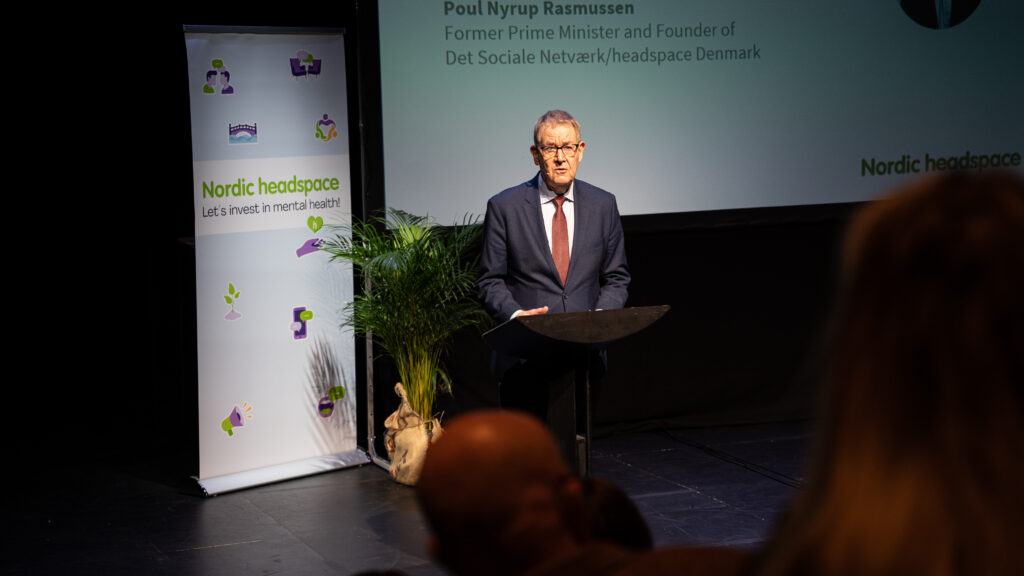
Nordic headspace Conference Gave Youth a Voice and Highlighted Smart Investments
November 18 Copenhagen’s Royal Danish Playhouse hosted the first Nordic headspace conference in Denmark. The event brought together researchers, politicians, business leaders, and young people from across the Nordic countries to discuss investments in youth mental health.
Finance Minister Nicolai Wammen opened the conference with a speech emphasizing the importance of prioritizing mental well-being, not only as a minister but also as a father. The musician URO set the tone with heartfelt songs.
A key topic was the inclusion of young people in decision-making processes. The day’s debates included discussions on young people’s expectations of the labor market, presented by Christine Ravn Lund of the Danish Youth Council and Falck’s CEO Jakob Riis. A youth panel also shared their perspectives on challenges such as future uncertainty, finances, and well-being.
The conference featured international contributions, including insights from Professor Martin Knapp, who highlighted the economic benefits of investing in mental health, and WHO’s Cassie Redlich, who showcased effective health initiatives.
A heartfelt thanks to all participants and moderator Nynne Bjerre Christensen for an inspiring day that strengthened collaboration on youth mental well-being both in the Nordics and globally. As founder Poul Nyrup Rasmussen concluded: “Those who give much, receive much.”
Read more about the Nordic headspace Conference 2024 here.
headspace Denmark’s low-intensity volunteer model has recently been recognised by Orygen, the world’s leading research organisation in youth mental health. The report explores other low-intensity service approaches around the world, provides an in-depth description of the headspace Denmark model and includes considerations for its adaptation and implementation into new settings. As the report concludes, “The headspace Denmark approach provides a promising model for adaptation to a diverse range of settings and different cultural contexts.” You can read the report here.
We hope that this will inspire others to consider how low-intensity models such as this can be effectively utilised to better support young people’s mental health and wellbeing in different resource settings around the globe. The report was launched online on the 19th November. You can watch the recording of the launch event here:
Contact sopr@detsocialenetvaerk.dk if you’d like to know more or would like to implement a similar approach in your context.
Ukraine today faces profound social, economic, and political fragility after more than three years of war. The conflict has created widespread uncertainty, with children and young people facing some of the most severe challenges. Many live under extremely stressful conditions and are affected by the trauma of war.
In 2022, Olena Zelenska launched the “All Ukrainian Mental Health” program, aiming to improve mental health services for children and young people through prevention efforts and by breaking down barriers to seeking help. Recognising the importance of accessible early intervention, Zelenska sought collaboration with headspace Denmark to address not only the horrors of war but also issues like loneliness, bullying, social isolation, and negative experiences on social media.
The partnership between headspace Denmark and Ukraine was officially established in the autumn of 2024 through a two-year agreement with the Olena Zelenska Foundation, the Coordination Center for Mental Health, and Ukrainian civil society organisations.
This collaboration has been built on mutual visits and meetings, laying the groundwork for a meaningful and long-term partnership. In April 2024, Olena Zelenska visited headspace Denmark, followed by headspace Denmark’s participation in the Fourth Summit of First Ladies and Gentlemen in Kyiv, where former Prime Minister of Denmark, founder and patron Poul Nyrup Rasmussen delivered a keynote speech. Most recently, a Ukrainian delegation visited Denmark in November 2024 to outline a strategic plan. In 2025, we will host Ukrainian professionals for training in our counselling model, and volunteer recruitment, training and management practices.
Youth Space 12-21 will be modelled on headspace Denmark’s approach, which uses volunteer-led support to promote and prevent mental health issues among young people. headspace Denmark will spearhead capacity-building activities to empower local Ukrainian staff, focusing on volunteer management, service design, delivery, and engagement with public systems. Youth Space 12-21 will then take the lead in establishing the service, supported by partnerships with public authorities and other local stakeholders.
By October 2025, the first five Youth Space centres are set to open, with plans for national scaling following the pilot phase. Support from Sagitta Charity Foundation and Stubkjær Family Group make this project possible, and headspace Denmark and our Ukrainian partners are making important progress toward creating safe spaces for young people in Ukraine.
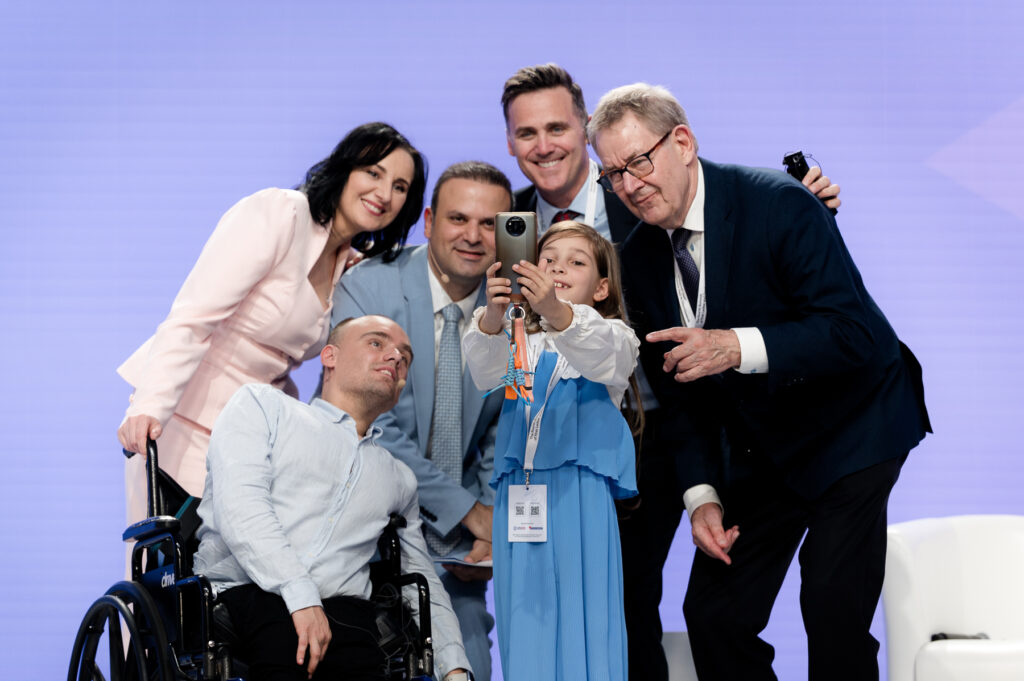
Photo: Anton Kulakowski
Det Sociale Netværk at the Fourth Summit of First Ladies in Gentlemen
In September 2024 a delegation from Det Sociale Netværk, led by founder Poul Nyrup Rasmussen, visited Kyiv for the Fourth Summit of First Ladies and Gentlemen. The mental health of children and young people was high on the agenda, including recent research that demonstrated the significant psychological toll of the war on young people and the need for accessible early intervention services, such as what headspace Denmark offers.
In his speech, Poul Nyrup Rasmussen highlighted the urgent need and the opportunity for headspace Denmark to provide support: “Russia’s war against Ukraine has put the country’s children and young people under daily pressure, and there is therefore a need for new and greater special help. Here, headspace Denmark can offer a collaboration that we know works and that can be built and expanded to all of Ukraine.”
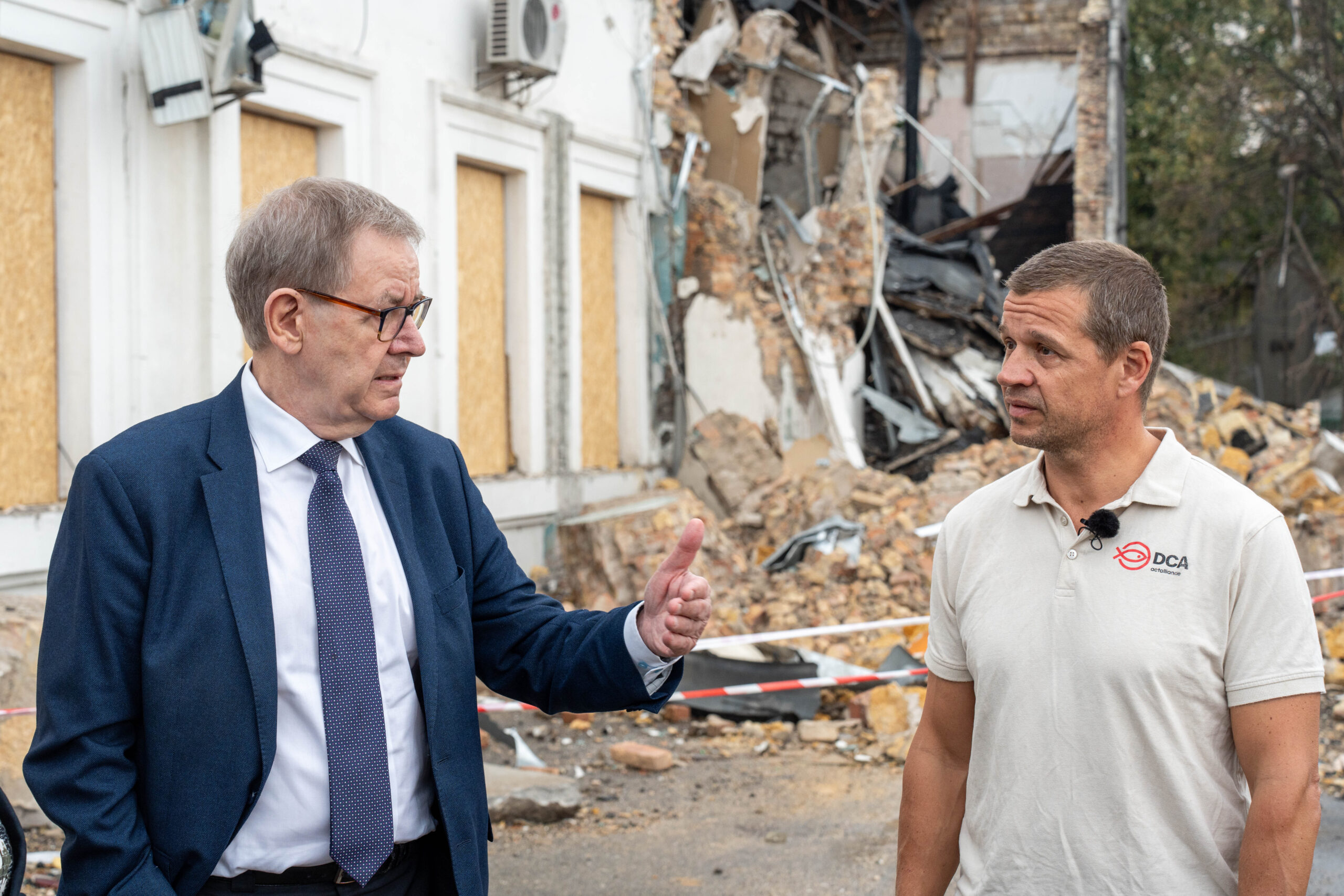
Read more about The Fourth Summit of First Ladies and Gentlemen here.
Bergið in Iceland, Mental Helse in Norway and headspace Denmark have agreed to collaborate on improving children’s and young people’s wellbeing across the Nordic region. The collaboration has four primary goals:
- To ensure that health promotion and prevention take a much more central position in youth mental health support.
- To advocate for the essential involvement of civil society in providing support to children and young people, in collaboration with the public sector.
- To advocate for sustainable and long-term financing of civil society proposals such as headspace throughout the Nordic region, allowing us to focus on helping young people rather than seeking funding; and
- To expand our approach to all the Nordic countries, adapted to local conditions and traditions.
The Nordic collaboration aims to revolutionise the Nordic welfare models in order to reverse the trends of mental distress among children and young people. One of the means is a stronger commitment to collaboration between the Nordic governments, municipalities, and civil society in the Nordic countries. Increased support for contributions from civil society can also alleviate the shortage of qualified labour within public health services in the Nordic countries.
Every year we gather for our annual international conference, which we host on a rotating basis.
Let’s invest in mental health, 2024
In November 2024, headspace Denmark hosted the conference titled, Let’s invest in mental health. The event took place at Copenhagen’s Royal Danish Theatre and brought together researchers, politicians, business leaders, and young people from across the Nordic countries to discuss the importance of investing in youth mental health.
The Danish Finance Minister Nicolai Wammen opened the conference with a speech emphasising the importance of prioritising mental wellbeing, not only as a minister but also as a father.
A key topic was the inclusion of young people in decision-making processes. The day’s debates included discussions on young people’s expectations of the labour market, presented by Christine Ravn Lund of the Danish Youth Council and Falck CEO Jakob Riis. A youth panel also shared their perspectives on challenges such as future uncertainty, finances, and well-being.
The conference featured international contributions, including insights from Professor Martin Knapp, who highlighted the economic benefits of investing in mental health, and WHO’s Cassie Redlich, who showcased effective health initiatives.
A heartfelt thanks to all participants and moderator Nynne Bjerre Christensen for an inspiring day that strengthened collaboration on youth mental wellbeing both in the Nordic region and globally. As former Prime Minister of Denmark and founder Poul Nyrup Rasmussen concluded: “Those who give much, receive much.”
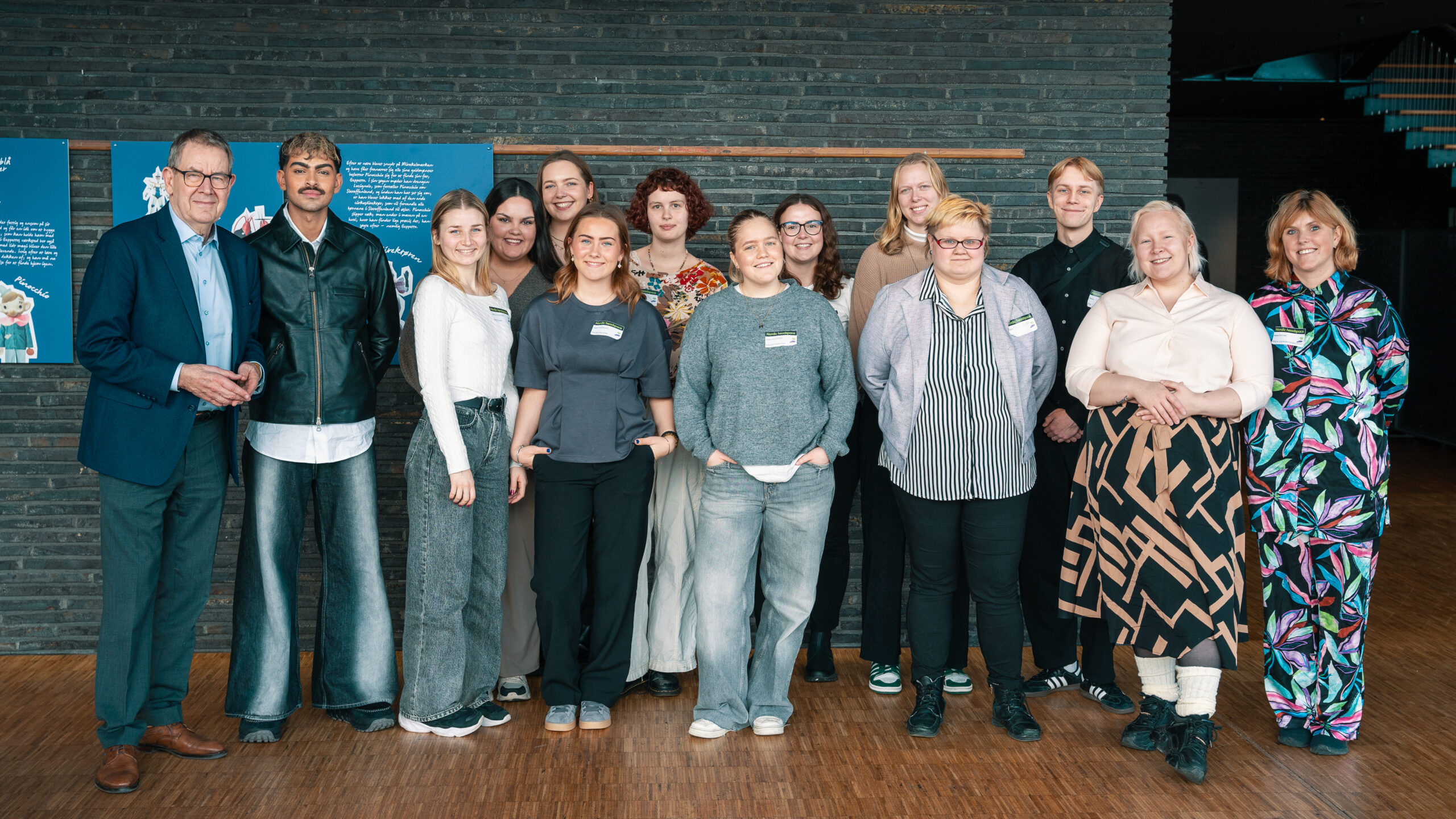
Image: Poul Nyrup Rasmussen and the panel of young people at the Nordic Conference 2024
The Nordic Collaboration’s focus in 2025: mental health in the workplace
Challenges with finding employment, or with their current job, are common reasons that young people seek support from headspace in Denmark, Norway and Iceland. Further, disengagement from education and work is a growing challenge and a political priority across Europe. For this reason, workplace mental health is the Nordic collaboration’s priority for 2025, and we are exploring partnerships to scaffold young people’s transition into the workforce, promote wellbeing and prevent disengagement from young people in employment, and build the capacity of employers to promote mental wellbeing among their young employees.
headspace Denmark was excited to once again participate in the International Association of Youth Mental Health conference, hosted in March 2025 in Vancouver, Canada. The event was a valuable opportunity to share some of our exciting work:
- Initial results from the recent evaluation of headspace Denmark, presented by Trine Hammershøy, CEO of headspace Denmark
- The goals and opportunities for the Nordic Collaboration, presented by Nina Moss, Head of the International Department
- The headspace Family pilot program, presented by Trine Hammershøy, CEO of headspace Denmark
- The When Something Makes You Happy board game, designed to promote reflective conversations about wellbeing, presented by Nadia Kamber Aa, project manager at headspace Denmark
- headspace Denmark’s health promotion outreach activities
- The mindU program, promoting wellbeing among young people preparing for confirmation
In collaboration with MEP Christel Schaldemose, Vice President of European Parliament, we hosted a working lunch in January 2025 titled: a cross-sectoral, collaborative approach to youth mental health and the role of civil society in health promotion, prevention and early intervention. This event brought together 60 delegates from the European Parliament, European Commission, the World Health Organisation, the World Economic Forum, NGOs across Europe and young people for an engaging discussion on opportunities for civil society in improving the mental health of young people across Europe.
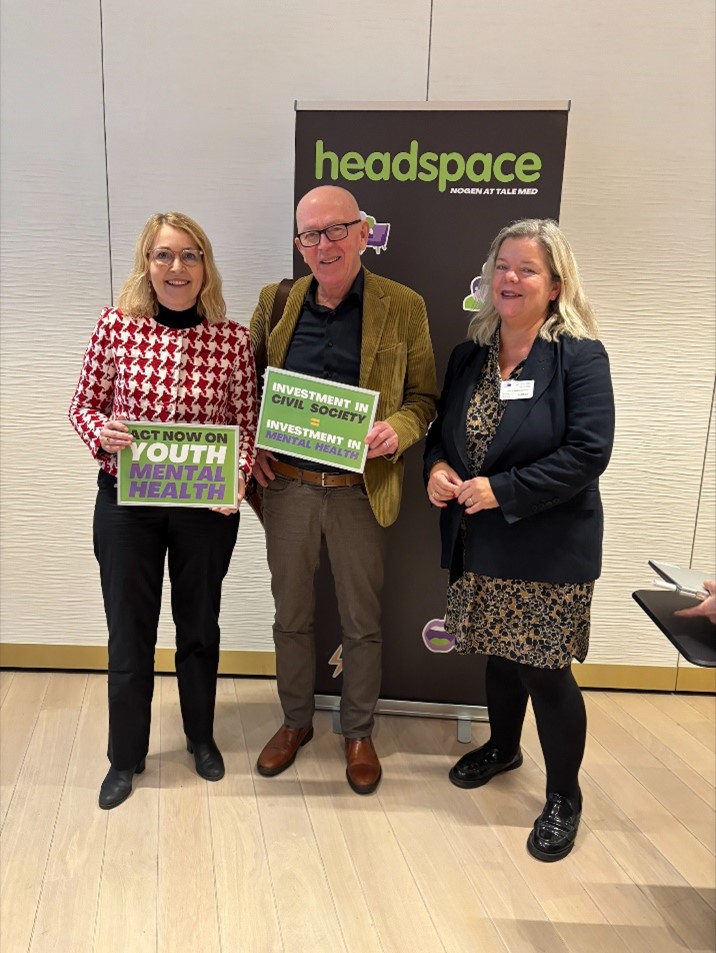
Image:MEP Christel Schaldemose, MEP Villy Søvndal and Trine Hammershøy
The event opened with an address from MEP Christel Schaldemose, identifying the importance of youth mental health on the European Parliament agenda, and stories from two young people: Anna-Sophie Albrink Hautopp, who shared her experience of counselling support from headspace Denmark, and Misha Meijers, a young peer volunteer at @ease in the Netherlands. Dr Mark van Ommeren, Head of the Mental Health Unit at the WHO Headquarters, then highlighted the value and effectiveness of non-specialist approaches to mental healthcare across the world, and Dr Ruma Bhargava, Global Lead of Mental Health at the World Economic Forum, recognised the importance of public-private collaboration to meet the mental health needs of young people. The important and effective contributions civil society is already making in this area were then clearly demonstrated by Poul Nyrup Rasmussen and Trine Hammershøy of headspace Denmark, Britta Lange of the Guldborgsund Municipality and Therese van Amelsvoort from @ease. We concluded with a lively discussion about next steps.
You can see the program and key messages here.
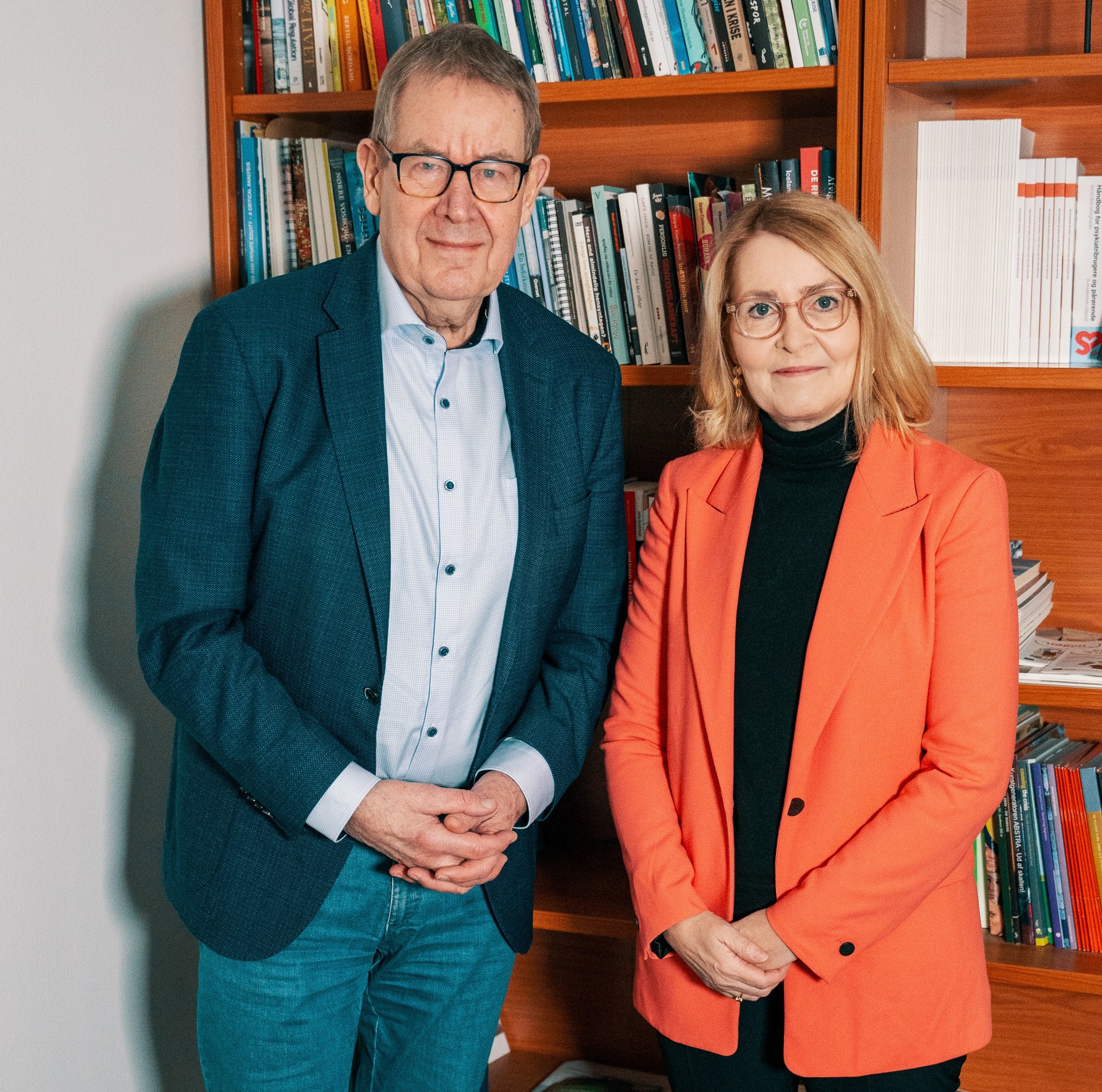
Image: Poul Nyrup Rasmussen and MEP Christel Schaldemose
Contact Us
Interested in collaborating, or want to learn more? Reach out to the team below.
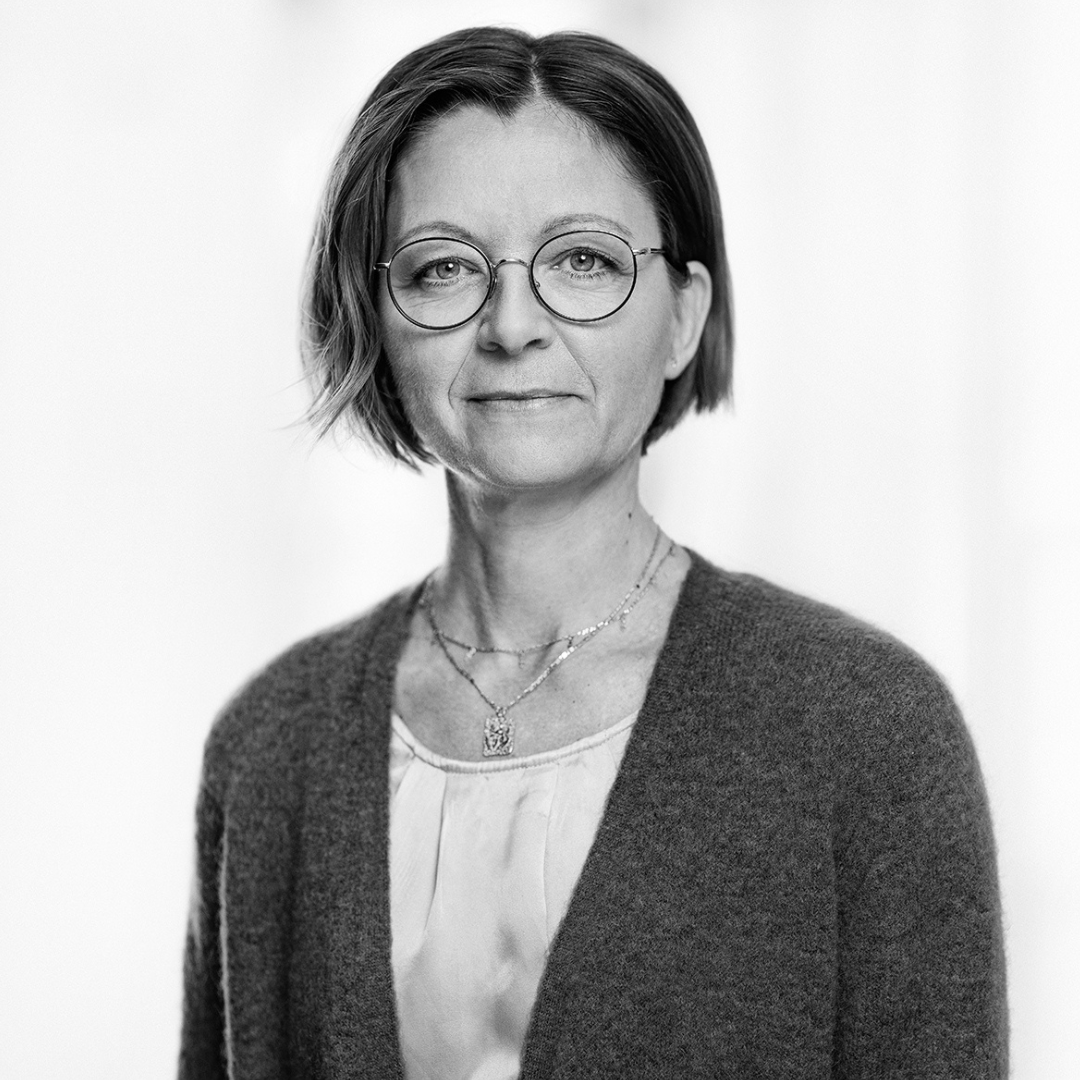
Nina Moss
Head of the International Department nimo@detsocialenetvaerk.dk
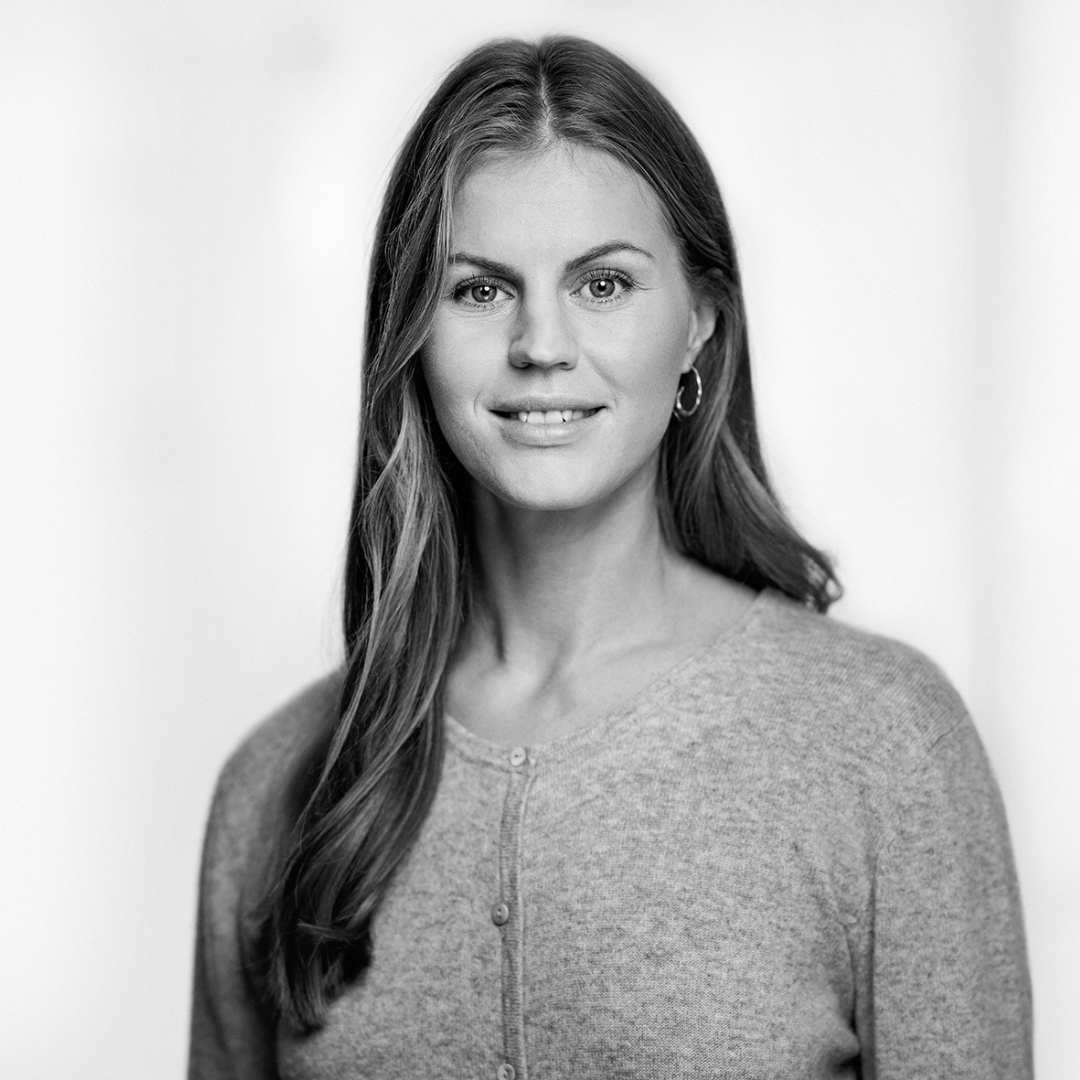
Julia Adelsten Olsen
Project Consultant jaol@detsocialenetvaerk.dk